
How much time to you spend in your head, thinking, worrying or ruminating? When was the last
time you stopped to tune into your body – to really notice what it might be trying to tell you? These
questions are worth asking because so many of us feel completely cut off from our own physicality.
Studies consistently show, for example, that only around 35% of us can accurately perceive our
own heartbeat. [1]
And this matters because poor interoception – the diminished ability to become aware of and
interpret internal bodily signals such as heart rate, breath rate, hunger, and pain – has been
strongly linked with anxiety, depression, eating disorders and even addiction.
When someone is anxious, poor interoception may show up as hypervigilance or, conversely, a
complete detachment, leading to panic attacks when sensations, such as a racing heart, are
misinterpreted. Alterations in interoception have also been closely linked with dissociation – a
profound sense of remoteness, which is often described as an emptiness, numbness or looking
from the outside in. And in patients with chronic pain, lower interoceptive accuracy has been
associated with higher pain-related distress.
We are living in a time of digital overload and a culture that often promotes external success over
internal emotional wellbeing. It doesn’t take a genius to make a link between the way we have
been socialised to live and the unintended consequences, including the global mental health crisis
and the epidemic in loneliness. How can we hope to make meaningful connections with others
when we are fundamentally disconnected from ourselves?
One interesting theory is that of the Canadian doctor and author Gabor Maté, who argues that
Western society is inherently toxic, failing to meet our fundamental human needs. This starts in
childhood, where excessive pressure to achieve – exam results, sports, performance – often take
precedence over secure connection. And when a child’s emotions, needs, or authenticity are not
accepted or safe to express, the nervous system shuts down awareness of feelings and bodily
signals as a way to cope.
Over time, this becomes habitual. We learn to override tiredness, pain, and gut feelings. We lose
trust in our internal sensations. Maté stresses that this isn’t a personal failure, but an adaptation that
once helped us to survive overwhelming experiences, but later manifests as dissociation, shame,
and difficulty being with the body.
In the Myth of Normal, he says: “In the absence of relief, a young person’s natural response – their
only response, really – is to repress and disconnect from the feeling-states associated with
suffering. One no longer knows one’s body. Oddly, this self-estrangement can show up later in life
in the form of an apparent strength, such as my ability to perform at a high level when hungry or
stressed or fatigued, pushing on without awareness of my need for pause, nutrition, or rest.” [2]
Ultimately, Maté says, the body will protest and say no. We get sick. We are forced to stop and pay
attention.
Maté suggests that the path back to true health, both individually and collectively, begins with
reconnection to our authentic selves by becoming present – with the body and with emotions. He
also recommends compassionately observing ourselves without judgement, which breaks the cycle
of shame and trauma.
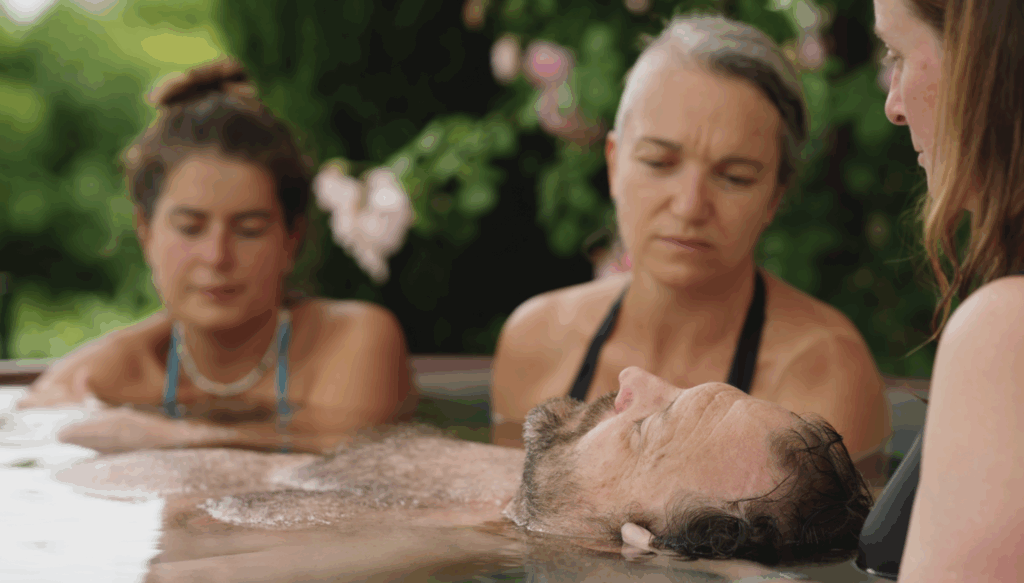
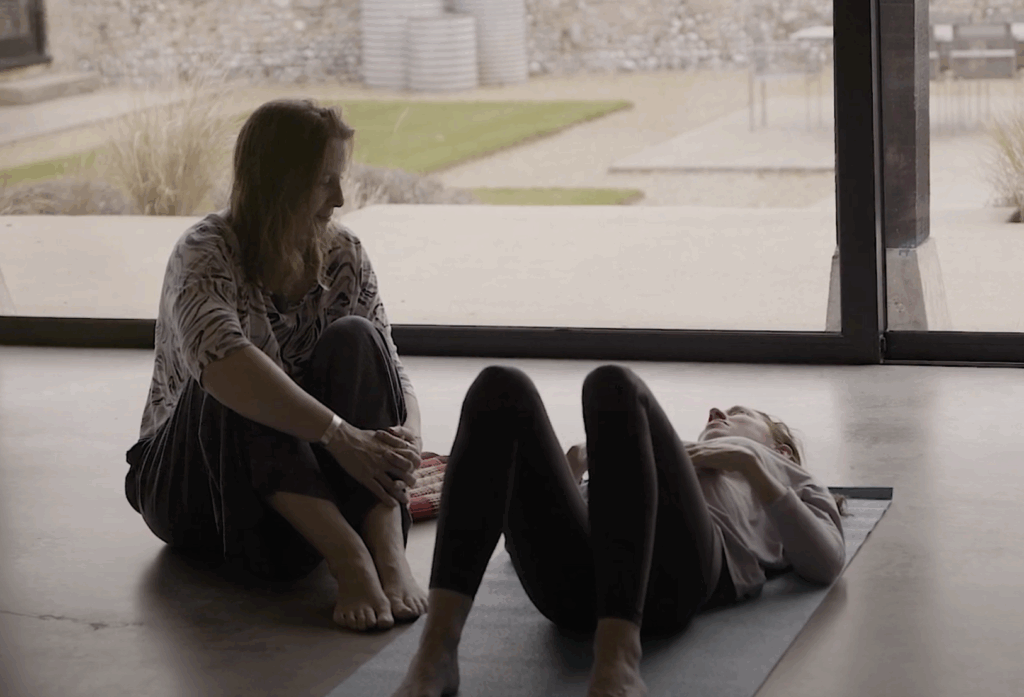
These elements are at the heart of Rebirthing Breathwork. One of the key aspects of a session is
the concept of ‘awareness in detail’, which involves paying close attention to the sensations that
arise with each consciously connected breath.
We are encouraged to move towards those areas holding tension or discomfort. We learn to be
with them, without trying to change what’s there. Instead, we notice the internal shifts and changes,
however subtle they may be. Crucially, we don’t judge, but instead, stay curious. As interoceptive
awareness deepens, we may recognise how we habitually hold tension in our jaw or restrict our
breath in response to stress, and we use connected breathing to gently reorganise these patterns.
We learn to pick up on what the body is whispering before it needs to shout.
For some people, the challenge at first can be to feel anything at all. It’s not uncommon to feel
nothing or numb. But this too is a source of information – something to be explored. We gently
embrace the nothingness by asking, what is it like? Even if the session feels uneventful, the act of
gently breathing in a complete circle of energy is still affecting the nervous system, reducing stress
and moving towards relaxation. The key to overcoming numbness is simply the willingness to
experience whatever is there, including the numbness itself. This can take time. Striving for a big
experience or a dramatic breakthrough is not the aim here. Staying present is!
Strengthening our interoceptive ability through Rebirthing Breathwork can also help us reframe
some of our long-held, often negative, self-limiting beliefs. We not only feel what is happening
internally, but also give ourselves the chance to pause in the moment and to decide what these
internal signals mean. We naturally start to learn to respond, rather than react.
Before speaking in public, for example, we may experience a fast heart rate, shallow breathing and
sweaty palms. These can all indicate anxiety, but they are all signs of excitement too. So in this
example, we can start to shift our internal dialogue from one that tells us we are frightened, not
good enough and therefore doomed to fail, to one that says that those butterflies in our stomach
mean this is an exciting opportunity to grow. Rebirthing says that thought is creative and that we
can decide what meaning and perspective we assign to events, rather than passively accepting the
unconscious beliefs we have inherited from the past.
In the words of the incredible psychologist, author and Aschwitz survivor, Edith Eger: “Change is
about noticing what’s no longer working and stepping out of the familiar imprisoning patterns.” [3]
Rebirthing Breathwork gives us this opportunity – to be present with what is there and to choose
how we respond to it. To let go of what holds us back, making more room for more joy and
aliveness. To reconnect with our bodies, our true selves and each other. In a world that can feel
polarised and fragmented, this is surely needed now, more than ever.
written by Daisy O’Clee
[1] Perceptual insensitivity to the modulation of interoceptive signals in depression, anxiety, and
substance use disorders, 2021, Ryan Smith et al.
https://pmc.ncbi.nlm.nih.gov/articles/PMC7822872/
[2] The Myth of Normal, Gabor Maté, 2024.
https://drgabormate.com/book/the-myth-of-normal/
[3] The Choice, Edith Eger, 2017.
https://dreditheger.com/